
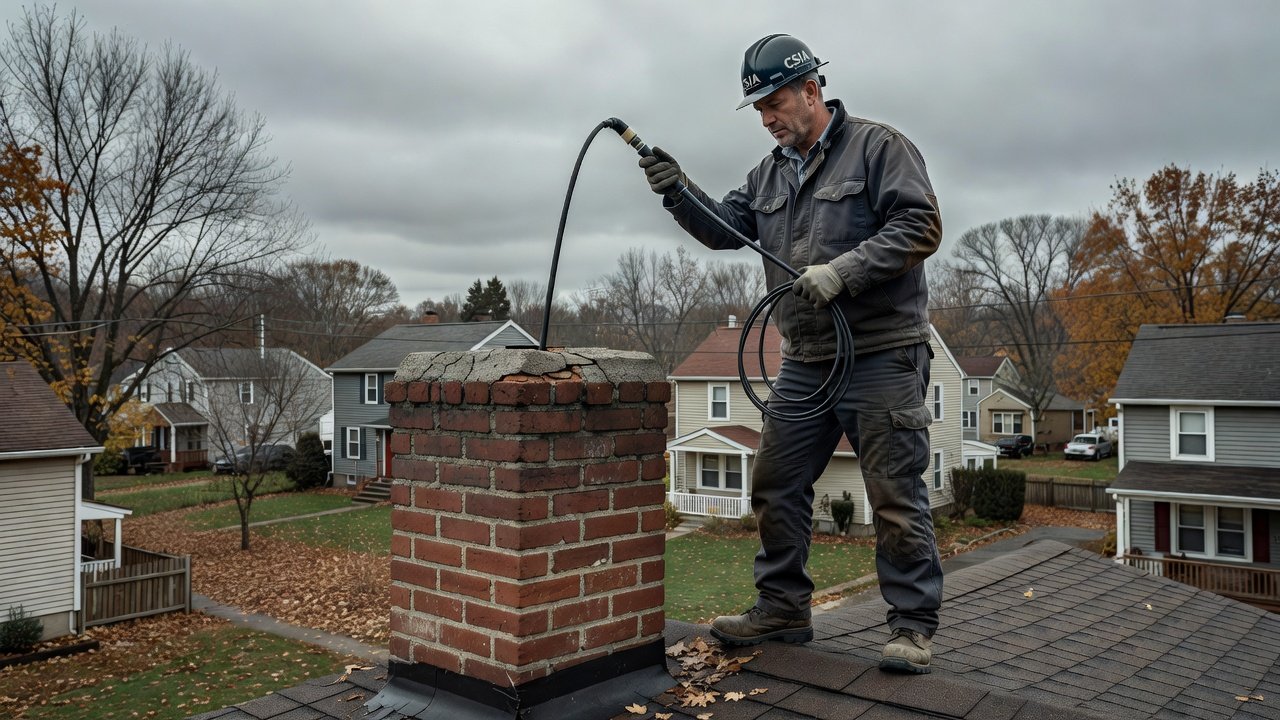
Essential Chimney Safety Inspection Yonkers NY: 2026 Guide for Spring Valley, NY Residents
Most homeowners assume that if the fireplace lights and the smoke go up, the chimney is fine. That assumption sends thousands of families to the emergency room every year and in Rockland County, where older housing stock is everywhere from Spring Valley to Chestnut Ridge, it’s a gamble we see go wrong more often than we’d like. A chimney safety inspection in Yonkers NY and the surrounding area isn’t a formality. It’s a diagnostic process, and what it finds or doesn’t find can determine whether your home stays safe through the heating season.
Last January, a homeowner in the Concord Road corridor of Spring Valley called us after noticing a faint, acrid smell in the living room every time the heat kicked on even with the fireplace unused. Our technicians arrived expecting a minor draft issue. What we found was a significant liner crack that had been directing combustion gases toward the framing cavity for at least one full heating season. The homeowner had no idea. No smoke alarm triggered because the carbon monoxide was dispersing slowly, not spiking. That’s exactly the kind of problem a visual glance at the firebox will never reveal.
What a Real Inspection Actually Diagnoses and What It Doesn’t
There’s a version of “chimney inspection” that amounts to a tech leaning over the firebox with a flashlight and telling you everything looks good. That’s not what we do, and it’s not what NFPA 211 requires. A proper inspection examines the firebox, smoke chamber, liner condition, exterior masonry, cap, crown, and flashing each of which can harbor a separate, independent failure mode.
The CSIA recommends that all chimneys, fireplaces, and vents be inspected at least once a year and cleaned as needed to reduce fire and carbon monoxide risks. For homes in Spring Valley and the wider Rockland County area many of which were built in the 1950s through 1970s with terracotta tile liners annual inspection isn’t a luxury. Tile liners age, shift with freeze-thaw cycles, and develop hairline cracks that are invisible to anything short of a camera scan.
Six Problems We Regularly Diagnose and How We Actually Fix Them
1. Cracked or Deteriorated Flue Liner
Symptoms: Smoky odor in the house when the fireplace isn’t in use, carbon monoxide detector readings above baseline, or visible white efflorescence on interior walls near the chimney chase.
Likely cause: Thermal cycling over decades causes terracotta tile sections to crack at the mortar joints. In Spring Valley homes built before 1980, the original liner may have never been replaced. A gas insert retrofitted onto an undersized or unlined flue accelerates the damage because the cooler exhaust condenses into acidic moisture that eats mortar from the inside.
Professional fix: A Level 2 inspection with camera required under NFPA 211 any time a home is sold or after any event that could have damaged the chimney will map the crack locations precisely. Depending on the extent, we either repair individual joints with refractory mortar, install a stainless-steel liner, or apply a poured-in-place liner system that encapsulates the entire flue. A homeowner cannot safely assess liner condition without a camera. Period.
Can this be prevented? Annual inspections catch hairline cracks before they migrate through the tile. Burning properly seasoned wood also reduces the thermal shock that accelerates cracking.
2. Stage 3 Creosote Buildup
Symptoms: A shiny, tar-like glaze visible in the firebox or on the damper. Reduced draw. A chimney fire that sounded like a freight train.
Likely cause: Burning wet or unseasoned wood, restricted air supply, or smoldering fires that never fully combust. Creosote builds in stages Stage 1 is dusty and brushes off easily, Stage 2 is flaky and needs rotary tools, Stage 3 is glazed and chemically bonded to the liner. According to the CSIA, Stage 3 creosote becomes highly flammable and can ignite at temperatures as low as 451°F.
Professional fix: Stage 3 requires chemical treatments applied over multiple visits to convert the glaze into a brushable ash, followed by mechanical removal. This is not a job for a homeowner with a chimney brush from a hardware store. In some cases, particularly in older homes in neighborhoods like Hillcrest or New Hempstead we find that Stage 3 buildup has damaged the liner underneath, which means a liner repair follows the cleaning.
Can this be prevented? Burn only dry, seasoned hardwood. Keep the damper fully open during fires. Have the flue swept annually before creosote advances a stage.
3. Damaged or Missing Chimney Cap
Symptoms: Water stains on the ceiling near the chimney, rusted damper, animal noises from the flue (raccoons and squirrels in Rockland County are not shy), or debris in the firebox.
Likely cause: The original galvanized cap corroded. High winds common on exposed ridgelines around Wesley Hills blew it off entirely. Or there was never one installed.
Professional fix: We install a stainless-steel cap sized to the flue dimensions, with a mesh skirt that excludes animals and a wide overhang that sheds water away from the crown. The homeowner can see whether a cap is present from the ground but cannot safely assess the crown condition or fit a proper replacement from a ladder without training and equipment.
Can this be prevented? Yes, a quality stainless cap with a lifetime warranty is a one-time fix. Don’t let a contractor sell you galvanized.
4. Failed Chimney Crown
Symptoms: Visible cracks across the top of the masonry chimney, spalling brick near the top courses, water intrusion after rain.
Likely cause: Crowns poured with regular concrete rather than refractory or crown-specific mix shrink and crack. Spring Valley and nearby Monsey get significant freeze-thaw cycling every winter, which turns hairline cracks into open channels.
Professional fix: Small cracks respond well to a flexible elastomeric crown coat applied by our technicians. Crowns that have failed structurally need to be chipped off and rebuilt with the correct mix and a proper overhang to shed water. A homeowner with caulk and a tube of roofing sealant will buy a season at best.
5. Flashing Failure
Symptoms: Water staining on the ceiling directly adjacent to the chimney, damp attic framing near the chimney penetration, interior mold smell.
Likely cause: The step flashing or counterflashing has separated from the chimney masonry. On many Spring Valley homes from the 1960s and 70s, the original flashing was embedded directly in mortar joints that have since cracked. Roofers often apply caulk over failing flashing rather than replacing it properly.
Professional fix: We reflash using two-piece counter-flashing base flashing woven into the roof shingles, counter-flashing embedded and sealed into regletted masonry joints. The diagnostic reasoning here matters: ceiling stains alone don’t confirm flashing failure. We rule out a cracked crown and liner condensation before pulling flashing.
6. Firebox Mortar Joint Erosion
Symptoms: Sandy grit accumulating on the firebox floor, visible gaps between firebrick, discoloration or heat marks migrating outside the firebox.
Likely cause: Standard mortar cannot survive sustained high-heat exposure. It erodes gradually, and homeowners often don’t notice until the gaps are significant. This is common in original fireplaces in Suffern-area homes that have been burning wood continuously for forty or fifty years.
Professional fix: Eroded joints are repointed with refractory mortar rated for firebox temperatures. Cracked firebrick is replaced individually. If the damage has progressed to the smoke shelf or smoke chamber, we apply a parged smoke chamber coating to restore a smooth, code-compliant surface. A homeowner can purchase refractory mortar at a hardware store, but without knowing where to stop and whether the damage has reached the outer shell DIY repointing routinely misses the actual problem.
What You Can Actually Do Yourself and Where to Stop
We’re not going to tell you that homeowners can’t do anything. You can keep the area around the firebox clear of combustibles. You can check that the damper opens fully before lighting a fire. You can burn seasoned hardwood instead of pine or treated lumber. You can look at the firebox with a flashlight and notice obvious debris, bird nests, or large cracks. These are all real contributions to chimney safety.
What you cannot safely do: assess liner integrity, evaluate creosote stage, diagnose flashing failure from the attic, or determine whether a carbon monoxide pathway exists. According to the U.S. Consumer Product Safety Commission, approximately 20,000 Americans visit emergency rooms annually due to carbon monoxide poisoning from heating equipment and most of those incidents involve exposures that built slowly, not all at once. The chimney safety inspection exists precisely because the failures that matter most are the ones you can’t see without equipment and training.
According to the National Fire Protection Association, failure to clean chimneys is the leading contributing factor in home heating fires, accounting for 31% of such fires. In a densely populated county like Rockland, where homes in Nanuet and Spring Valley sit close together on small lots, a chimney fire doesn’t just threaten one family.
What Happens When You Call Us
When a Spring Valley homeowner contacts us, we start with a plain-language conversation about what you’ve noticed smells, sounds, water stains, anything that seemed off. Our certified sweep arrives with a camera system for the flue, proper lighting for the firebox and smoke chamber, and the experience to know what normal looks like for your chimney’s age and fuel type. We document everything photographically. If we find problems, we explain them in terms of what they mean for your family’s safety, not just what line item they fall on. If we don’t find problems, we tell you that too.
A professional chimney sweep in the Northeast typically runs between $129 and $378 depending on scope, according to HomeAdvisor’s 2022 survey data and a Level 2 inspection with camera adds to that, but it’s the inspection level that actually catches liner cracks and hidden damage. We’ll tell you exactly what we’re doing and why before we start.
Frequently Asked Questions
How often should a Spring Valley homeowner schedule a chimney safety inspection?
The CSIA recommends a chimney inspection at least once per year, regardless of how often you use the fireplace. For homes in Spring Valley and Rockland County that burn wood regularly through the winter, we also recommend a cleaning at that same visit. If you’ve had a chimney fire, purchased a home, or converted the appliance type gas insert replacing a wood fireplace, for example NFPA 211 requires a Level 2 inspection with camera before the system is used again.
My fireplace hasn’t been used in years. Do I still need a chimney safety inspection before lighting a fire?
Yes, in many ways, a long-unused chimney carries more risk than one that’s been regularly maintained. Animals can nest in the flue during dormant periods, mortar deteriorates whether or not fires are burning, and a cap or crown that failed years ago may have allowed water damage to progress silently. Before lighting any fire in a chimney that’s been idle, our certified sweeps will perform a full inspection to confirm the liner is sound, the damper opens freely, and the flue is clear.
We just bought a home in Spring Valley — does the seller’s chimney inspection paperwork mean we’re covered?
Not necessarily. A general home inspector is not trained or equipped to evaluate a chimney to NFPA 211 standards, and most home inspection reports explicitly exclude the interior of the flue. If the previous owner’s inspection was not performed by a CSIA-certified chimney sweep with camera documentation, it does not meet the Level 2 standard required at property transfer. We recommend every new homeowner in Spring Valley, Monsey, Chestnut Ridge, or surrounding Rockland County communities schedule an independent chimney inspection before using the fireplace regardless of what the home inspection report says.
Schedule Your Inspection with American Chimney Company
If you’re a homeowner in Spring Valley, Nanuet, Wesley Hills, Monsey, or anywhere in Rockland County and you’re not certain about the condition of your chimney, call us. Our certified sweeps serve this area year-round, and we’ll give you a straight assessment no pressure, no unnecessary upsells, just an honest look at what’s going on and what, if anything, needs to be done. Contact American Chimney Company today to request a certified chimney safety inspection and get through the heating season with confidence.
Related from American Chimney Company: Chimney Sweep & Cleaning in Yonkers, NY · Chimney Inspection (Level 1 & 2) in Stamford, CT · Essential Chimney Safety Inspection