
Trusted Masonry Chimney Restoration Hartford CT: 2026 Guide for Bridgeport, CT Residents
According to the National Fire Protection Association, failure to clean and maintain chimneys is the leading contributing factor in home heating fires, accounting for 31% of such incidents nationwide. Here in Bridgeport, that statistic carries real weight the city’s housing stock is old, the winters are hard, and a significant share of the chimneys we inspect have masonry problems that have been quietly getting worse for years. Most of the homeowners who call us are not negligent people. They simply had the wrong picture of what masonry chimney restoration actually involves, and that gap between expectation and reality delayed repairs long enough to turn a moderate job into a major one.
Last February, a homeowner in the Black Rock neighborhood called us about water stains appearing on the wall beside their fireplace. They assumed the problem was a roof leak. When our crew assessed the chimney, we found deep freeze-thaw cracking in the mortar joints from the firebox up through the crown, spalling brick on the upper third of the stack, and a deteriorated flashing seal. The water was entering through the masonry itself, not the roof. The repairs were manageable but the homeowner had been watching those stains for two winters, which allowed moisture to reach the interior wall framing. This happens regularly in Bridgeport’s coastal climate, where temperature swings between January and March can cycle through freezing and thawing dozens of times in a single season.
The Restoration Process Is Not a Single Afternoon Job
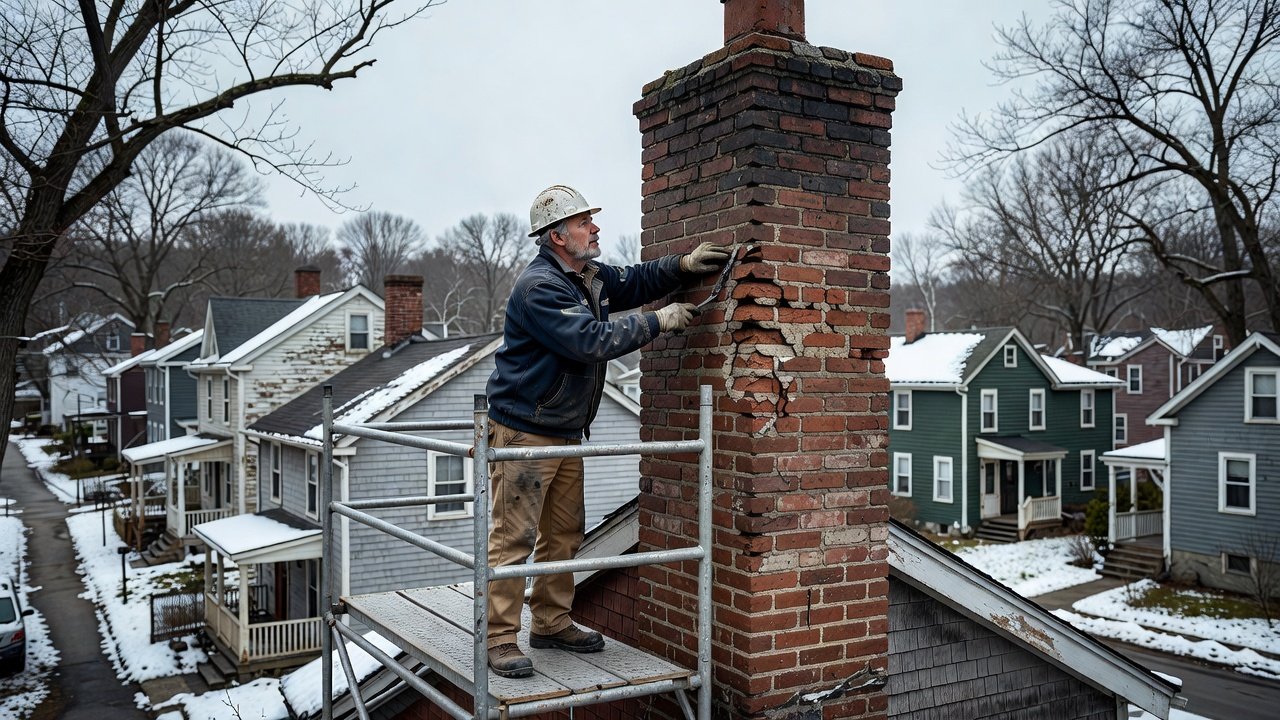
One of the most persistent misconceptions we encounter is that masonry chimney restoration is something a contractor knocks out in a few hours. Homeowners often picture a crew showing up, applying some fresh mortar, and leaving by noon. The reality is that a legitimate restoration can span multiple visits depending on scope, and the prep work alone cleaning the surface, removing deteriorated mortar to the correct depth, staging scaffolding or a lift on tight city lots takes time to do safely and properly.
Tuckpointing, for example, requires removing old mortar to a depth of at least three-quarters of an inch before new material is applied. If that depth is not reached, the new mortar bonds to deteriorated material and begins failing within a season or two. We see evidence of this cut-corner approach on chimneys throughout the North End and South End of Bridgeport surface-level mortar patches that look fine from the driveway but crumble when you press a thumb against them. Doing it right takes longer, costs a bit more upfront, and holds for decades.
Not All Brick and Mortar Problems Look the Same From the Ground
Homeowners frequently underestimate damage because they evaluate the chimney from the yard. This is understandable you can see the obvious spalling or the leaning cap, but a significant portion of masonry failures are not visible from street level. Hairline cracks in the flue liner, crown deterioration just below the cap, and mortar erosion on the back face of the stack (which faces away from the street) are routinely missed until a certified sweep gets eyes on them from the roof.
The CSIA recommends that all chimneys be inspected at least once a year, and NFPA 211 classifies inspections into three levels a Level 2 inspection is required after any event that may have damaged the structure, including severe weather events. Bridgeport and surrounding areas including Stratford and Shelton see their share of coastal storms that qualify. We have found significant crown fractures on chimneys in Trumbull and Fairfield whose owners had no idea anything had shifted until we documented it with a camera.
What Homeowners Get Wrong About the Cost
Sticker shock is real, and it causes people to delay. We understand that. But the cost misconception actually runs in both directions. Some homeowners expect masonry restoration to cost thousands automatically, panic, and avoid calling. Others expect a number closer to a routine cleaning and are caught off guard when the scope is larger. The honest answer is that cost depends heavily on how far the deterioration has progressed and how accessible the chimney is.
A 2022 HomeAdvisor survey found that most homeowners nationally pay between $129 and $378 for a chimney sweep, but masonry restoration is a separate category of work entirely. Tuckpointing a single face of a standard stack in Bridgeport typically runs between $400 and $900. Full crown replacement adds to that. If flashing needs to be reset or brick replacement is required, the total climbs further. The variable that controls cost more than anything else is timing catching mortar erosion at a 30% failure rate costs a fraction of what it costs when the entire joint matrix has opened up, and water has been running into the chase for multiple seasons.
Chimney Restoration and Chimney Relining Are Two Different Things
We field this confusion regularly. A homeowner calls saying they need their chimney “rebuilt,” and after asking a few questions it becomes clear they mean the flue liner needs relining after years of creosote buildup or thermal cracking not that the exterior masonry is failing. These are distinct scopes of work, though they sometimes occur together. Masonry chimney restoration refers specifically to the exterior brick and mortar structure: the stack, the crown, the hearth, and in some cases the firebox. Relining addresses the interior flue system.
Creosote, the tar-like byproduct of burning wood, becomes highly flammable at stage 3 buildup and can ignite at temperatures as low as 451 degrees Fahrenheit according to the CSIA. A chimney fire can damage both the liner and the surrounding masonry in a single event. When we get calls from homeowners in the East Side or the West Side of Bridgeport who have had a chimney fire even a small one that self-extinguished — we inspect both systems independently before recommending any repair scope.
The Idea That New Construction Chimneys Don’t Need Attention
Bridgeport has a large inventory of pre-1960 homes, but newer construction is not immune to masonry issues. Chimneys built with lower-quality brick or installed with insufficient mortar coverage during a cold weather pour can begin showing problems within five to ten years. We have restored chimneys in newer developments near the Stratford town line that failed well before their time because the original installation was rushed. Age is a risk factor, but it is not the only one.
What to Expect When You Call Us
When a Bridgeport homeowner contacts American Chimney Company, we begin with a full visual assessment roof access, interior inspection, and documentation of any masonry concerns. We walk you through what we find, show you photos, and explain the repair sequence clearly before any work begins. We do not upsell work that is not warranted, and we will tell you plainly when something can wait versus when it needs to be addressed before the next heating season. Our certified sweeps are familiar with the specific material and climate challenges that come with masonry chimney restoration in this part of Connecticut from the coastal salt air that accelerates mortar erosion to the freeze-thaw cycles that widen cracks faster than in inland areas.
Frequently Asked Questions About Masonry Chimney Restoration in Bridgeport, CT
How do I know if my chimney needs masonry restoration or just a routine cleaning?
A routine cleaning removes creosote and debris from the flue. Masonry restoration addresses structural issues with the brick, mortar, crown, or cap. If you notice white staining on the exterior brick, crumbling mortar joints, water entering around the fireplace, or visible cracking anywhere along the stack, those are signs that restoration work may be needed beyond a standard sweep. A Level 1 or Level 2 inspection will tell you exactly what is present and what the priority level is.
Can masonry restoration work be done in winter in Bridgeport?
Some work can be done in cooler temperatures with proper precautions, but mortar application has temperature and curing requirements that limit full restoration during hard freeze conditions. Most masonry contractors and our own team schedule full restoration projects for spring through fall. That said, we can complete temporary protective measures in winter to prevent a deteriorating situation from worsening until conditions allow for permanent repairs.
How long does masonry chimney restoration typically last before work is needed again?
When done correctly with quality materials and proper mortar depth, tuckpointing and crown repairs can last 20 to 30 years in normal conditions. In coastal environments like Bridgeport, where salt air and freeze-thaw cycling are more aggressive, we recommend an annual visual inspection so minor deterioration can be caught early. Applying a penetrating masonry water repellent after restoration can meaningfully extend the life of the repair in this climate.
If you have noticed any changes to your chimney’s appearance, are dealing with water intrusion near the fireplace, or simply have not had your masonry inspected in the last few years, we encourage you to reach out to our team at American Chimney Company. We serve homeowners throughout Bridgeport, Stratford, Shelton, Trumbull, and Fairfield with certified inspections and honest repair assessments. Call us or request a free estimate online protecting your home’s structure and your family’s safety is exactly what we are here to do.
Related from American Chimney Company: Chimney & Masonry Repair in White Plains, NY · Chimney Rebuild & Restoration in New Rochelle, NY · Chimney & Masonry Repair in Princeton, NJ