
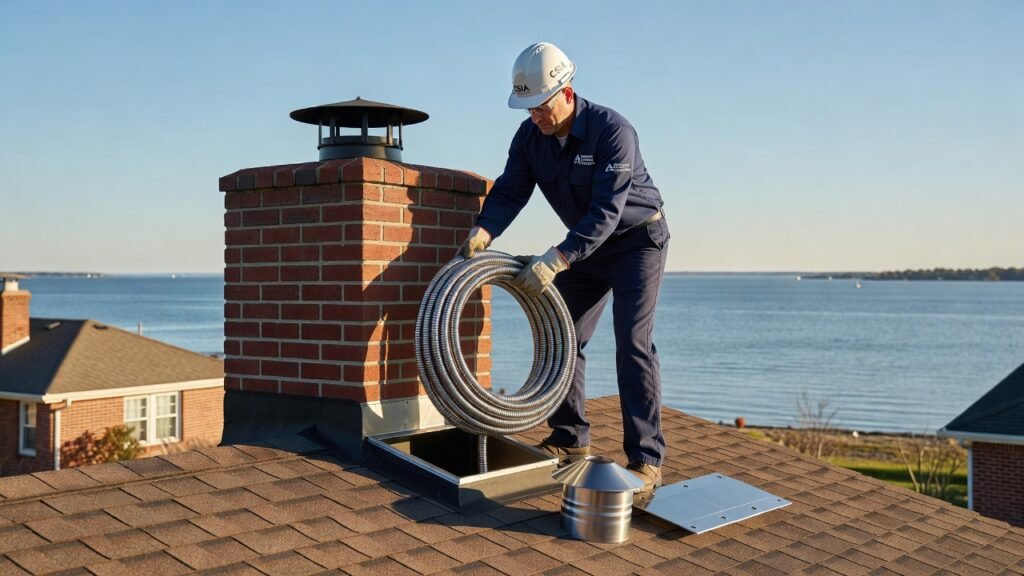
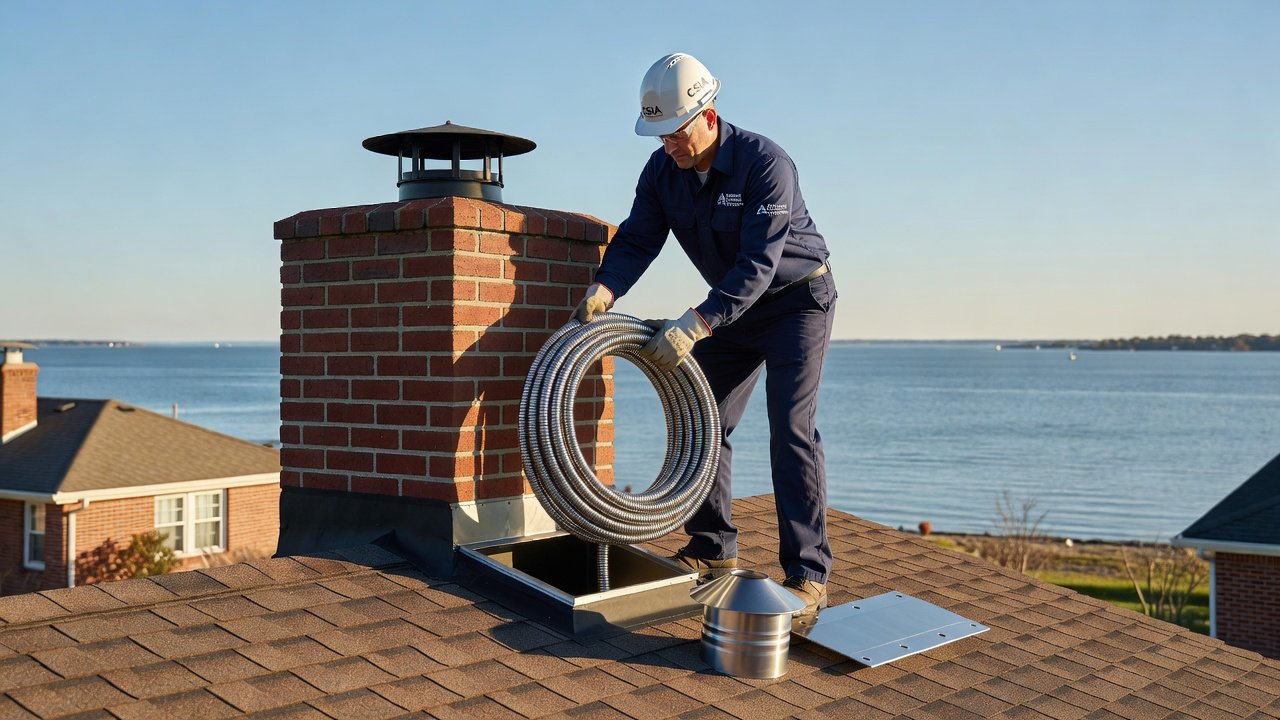
Chimney Liner Installation in Copiague, NY
Chimney liner installation is the process of fitting a protective sleeve typically stainless steel, cast-in-place, or clay tile inside your chimney flue so that combustion gases, heat, and sparks travel safely from your firebox to the outside air without ever touching your home’s masonry or framing. It matters because an unlined or damaged flue is one of the leading causes of house fires and carbon monoxide intrusion, and the National Fire Protection Association (NFPA 211) requires a correctly sized, continuous liner for virtually every solid-fuel appliance, gas insert, or oil furnace venting through a chimney. If your liner is cracked, absent, or mismatched to your appliance, every fire you light is a calculated risk and on Long Island’s South Shore, where older capes and ranch-styles from the 1950s and 1960s are common, that risk is surprisingly widespread.
At American Chimney Company, we see it regularly in Copiague: a homeowner replaces an old oil boiler with a high-efficiency gas unit, or converts a wood-burning fireplace into a gas insert, and suddenly the existing tile liner is the wrong diameter, the wrong material, or simply too far deteriorated to use. What started as a home improvement becomes a safety liability until the liner is addressed.
Why Copiague Homes Are Especially Likely to Need a New Liner
Copiague sits in the heart of western Suffolk County, and a large percentage of its housing stock was constructed between the late 1940s and mid-1970s as part of the post-war Long Island building boom. Many of those chimneys were built with unlined flues or with hand-laid clay tile that has now been subjected to 50-plus years of freeze-thaw cycles, salt air from the Great South Bay, and the acidic condensate produced by modern mid- and high-efficiency appliances.
Salt-laden coastal air accelerates mortar erosion in masonry flues. When the joints between clay tiles open up, flue gases including carbon monoxide can migrate into wall cavities and living spaces. A video inspection (Level 2, per NFPA 211 standards) frequently reveals liner failures that are invisible from the rooftop and that a simple sweep would never catch. If you have not had a Level 2 inspection in the last three years, or if you have recently added, replaced, or changed any heating appliance, you owe it to your household to find out what condition your liner is actually in.
The Three Liner Types We Install and How We Choose the Right One for Your Flue
Not every liner is right for every situation. Our recommendation is always driven by your appliance type, your flue geometry, and the condition of your surrounding masonry not by what happens to be on the truck.
Stainless Steel Flexible Liner Systems
A 316-grade or 304-grade stainless steel flexible liner is the most common solution for gas inserts, pellet stoves, and wood-burning appliances being rlined into an existing masonry chimney. Flexible liner is ideal when the flue has offset a common feature in older Copiague homes where the chimney was built to accommodate multiple fireplaces on different floors. We size the liner precisely to your appliance’s BTU output and flue connector diameter, insulate it with a wrap or pour insulation to maintain draft and reduce creosote condensation, and terminate it with a listed rain cap. The system is UL-listed and carries a manufacturer warranty.
Rigid Stainless-Steel Liner
When the flue runs perfectly straight from firebox to crown which occurs in some single-story ranch homes in Copiague rigid liner sections offer exceptional durability and an ultra-smooth interior surface that maximizes draft and minimizes creosote adhesion. Installation is faster, but it is only appropriate where clearances and geometry allow.
Cast-in-Place Liner Systems
For severely deteriorated masonry flues or situations where the surrounding tile and mortar are structurally compromised, a cast-in-place liner (a poured refractory material applied to the interior of the existing flue) can both reline the flue and consolidate a weakened chimney structure simultaneously. This is often the most economical path when tile replacement would otherwise require partial demolition of the chimney itself.
Our Chimney Liner Installation Process, Step by Step
We do not show up, drop in a liner, and collect a check. Every installation we perform in Copiague follows a consistent, documented process designed to eliminate surprises and ensure the finished system meets code.
- Pre-installation video inspection: Before any liner is ordered, we run a closed-circuit camera through the full length of the flue to document existing conditions liner integrity, offset locations, flue dimensions, and the condition of the firebox and smoke chamber. This footage belongs to you; you can watch it in real time and receive a copy.
- Accurate flue sizing: We calculate the correct liner diameter based on your appliance’s BTU rating, the flue height, and the number and degree of any offsets. Undersized liners draft poorly; oversized liners create condensation and accelerated creosote buildup. Correct sizing is not optional.
- Chimney prep: We clean the existing flue of any debris, loose tile fragments, or creosote before installation. This protects the new liner and ensures an accurate final fit.
- Liner installation and insulation: We lower the liner from the top and connect it to the appliance connector at the bottom. For gas and pellet appliances, we apply appropriate liner insulation wrap or pour insulation around the liner inside the flue chase to maintain flue gas temperature and prevent condensation.
- Top plate and rain cap installation: A stainless steel top plate seals the space between the liner and the flue tile at the crown, preventing water intrusion, animal entry, and debris from entering the annular space. A listed rain cap protects the liner opening itself.
- Final inspection and documentation: We test draft, inspect all connections, and provide you with a written installation record that you can submit to your insurance carrier or use for future inspections. We also outline the recommended maintenance schedule for your specific liner type.
What Every Chimney Liner Installation from American Chimney Company Includes
- Pre-installation Level 2 video camera inspection of the existing flue
- Correct liner sizing calculation matched to your specific appliance
- UL-listed stainless steel liner (grade selected for your fuel type) or cast-in-place system as appropriate
- Liner insulation where required by appliance type and flue height
- Stainless steel top plate and rain cap
- Removal and disposal of old liner materials (where accessible)
- Written installation documentation suitable for insurance or permit records
- Post-installation draft test and appliance connector inspection
- Clear maintenance recommendations and next-service timeline
Why Copiague Homeowners Trust American Chimney Company for This Work
American Chimney Company has been serving the South Shore of Long Island from Copiague for years. Our technicians are CSIA-certified chimney sweeps and inspectors meaning they have passed nationally recognized examinations in chimney safety, not simply on-the-job training. We carry full liability insurance and workers’ compensation coverage, which protects you if anything goes wrong on your property. We pull permits when your local municipality requires them, and we are familiar with the specific building stock and chimney construction common to Copiague neighborhoods, including the side-by-side capes near Wicks Road and the split-levels closer to the Great South Bay.
We do not subcontract liner installation work. The technician who inspects your chimney is the same technician who installs your liner and signs off on the job. That accountability matters when safety is the product.
Frequently Asked Questions About Chimney Liner Installation in Copiague
My house is on natural gas do I really need a liner if I convert to a gas insert?
Yes, and this is one of the most common misunderstandings we encounter on Long Island. Gas appliances produce acidic flue gases that rapidly deteriorate unlined masonry and erode mortar joints between clay tiles. Additionally, most high-efficiency gas inserts require a smaller diameter liner than the original wood-burning flue to maintain proper draft velocity without correct sizing, you get backdrafting and carbon monoxide risk. A correctly sized, listed stainless steel liner is required by both the appliance manufacturer and the National Fuel Gas Code (NFPA 54) for virtually all gas fireplace inserts.
How long does a stainless steel liner typically last in a coastal Long Island environment?
A 316L-grade stainless steel liner installed in a gas or oil-venting application and properly maintained typically carries a manufacturer warranty of 15 to 25 years, and many last considerably longer. The 316L alloy offers meaningfully better resistance to the sulfuric and carbonic acid condensates produced by modern appliances than the less expensive 304-grade material which is why we specify it for most gas and oil applications here on the South Shore. Annual inspections and keeping the liner free of debris extend service life significantly. We keep records of every liner we install in Copiague so we can flag it for inspection when it approaches the end of its rated service period.
Will Copiague or Suffolk County require a permit for chimney liner installation?
Permit requirements for chimney liner installation vary depending on the scope of work and whether it is connected to a new appliance installation. In many cases, relining an existing chimney for an existing appliance is classified as maintenance and does not require a separate permit, but when the work is associated with a new gas insert or appliance change-out, a mechanical permit may be required. American Chimney Company is familiar with current Town of Babylon and Suffolk County requirements and will advise you on permit obligations before work begins and handle the filing if one is needed.
Your Next Step: Schedule a Liner Assessment in Copiague Today
If your chimney is older, your appliance has been changed or upgraded, or you have never had a video inspection of your flue, do not wait for a problem to reveal itself through smoke in your living room or a carbon monoxide alarm at 2 a.m. American Chimney Company serves Copiague and the surrounding South Shore communities with honest assessments, properly sized liner systems, and work that is built to last in a coastal Long Island environment.
Call us to schedule your chimney liner installation consultation or pre-installation video inspection. We will tell you exactly what your flue needs and equally important, what it does not need so you can make an informed decision and heat your home with confidence this season.
Call American Chimney Company today or use our online contact form to schedule your Copiague chimney liner assessment. Same-week appointments are frequently available.
Related from American Chimney Company: Chimney Liner Installation in Greenwich, CT · Chimney Sweep & Cleaning in Yonkers, NY · Chimney Inspection (Level 1 & 2) in Stamford, CT