Essential Chimney Safety Inspection: 2026 Guide for Cherry Hill, NJ Residents
According to the National Fire Protection Association, failure to clean chimneys is the leading contributing factor in home heating fires, accounting for 31% of such fires. That number doesn’t shrink when you look at older housing stock and Cherry Hill, NJ has plenty of it. The split-levels and colonials built through the 1970s and 1980s in neighborhoods like Barclay Farm and Erlton South were fitted with masonry fireplaces that are now 40 to 50 years old. Most of them have never had a professional safety inspection.
Last November, a homeowner off Kresson Road called us after smelling smoke on the second floor every time she ran her gas insert. She assumed it was a draft issue. Our technicians found a section of deteriorated liner that had been pulling combustion gases into the wall cavity for at least one full heating season. The liner repair kept her family safe; the delay could have had a very different outcome. That call is not unusual for this part of Camden County.
Before You Start: What a Chimney Safety Inspection Actually Covers
A chimney safety inspection is not the same as a routine sweep. The CSIA recommends that all chimneys, fireplaces, and vents be inspected at least once a year and cleaned as needed to reduce fire and carbon monoxide risks. NFPA 211 the governing standard for chimneys, fireplaces, and vents defines three inspection levels. A Level 1 covers accessible portions and is appropriate for systems used under the same conditions as the prior season. A Level 2 is required any time a home is sold, after any chimney fire, or when the appliance type is changed. Most Cherry Hill homeowners buying a resale property need a Level 2 whether their real estate agent mentions it or not.
Before scheduling anything, gather what you know: the fuel type (wood, gas, oil), approximate age of the appliance, and any symptoms you have noticed smoke backing into the room, visible cracks in the firebox, a persistent odor when the fireplace is cold. That information helps our certified sweeps prioritize what to look for on arrival.
Step 1 — Look at What You Can See Without a Ladder
Start at the firebox. Run a flashlight along the rear wall and the smoke shelf above the damper. Look for mortar joints that are crumbling, bricks that have shifted, or a damper blade that won’t seat flat. Any of these is a reason to stop using the fireplace immediately and call for a professional inspection.
Then go outside and scan the crown and cap from the ground. If the crown the concrete or mortar cap at the very top of the masonry shows visible cracking, water is already working its way into the flue. In Cherry Hill winters, that freeze-thaw cycle does serious damage year after year. Homeowners in Woodcrest and Springdale who have maples or oaks overhanging their rooflines should also look for debris accumulation at the top of the chase.
Step 2 — Understand the Carbon Monoxide Risk Before It Finds You
Carbon monoxide has no smell, no color, and no warning signs you can detect without a working CO detector. The U.S. Consumer Product Safety Commission estimates that carbon monoxide poisoning from heating equipment including fireplaces and chimneys sends approximately 20,000 Americans to emergency rooms annually. A blocked or cracked flue on a gas appliance can push CO directly into living space.
Every floor of your home should have a functioning CO detector, but that is not a substitute for a sound flue. We see a consistent pattern in the homes we inspect along Route 70 and in the older sections of Haddonfield bordering Cherry Hill: gas log inserts retrofitted into masonry fireplaces with liners that were never resized for the lower flue temperatures gas appliances produce. An undersized or deteriorated liner on a gas insert is one of the more serious hazards we encounter, and it is invisible without camera equipment.
Step 3 — Schedule the Right Level of Inspection for Your Situation
Call a CSIA-certified chimney sweep and tell them your situation plainly. If you are buying a home in Cherry Hill or Voorhees and the listing says the fireplace is in “working condition,” request a Level 2 inspection in writing before closing. If you have been using the same appliance for multiple seasons with no changes and no symptoms, a Level 1 annual inspection is the standard starting point.
On pricing: a 2022 HomeAdvisor survey found the average cost of a professional chimney sweep ranges from $129 to $378, with most homeowners paying around $252 depending on region and scope. A Level 2 inspection with video scanning runs higher expect $300 to $500 in the Cherry Hill market. That is a fraction of what a chimney fire or a carbon monoxide event cost, in every sense.
Step 4 — Be Present During the Inspection and Ask Questions
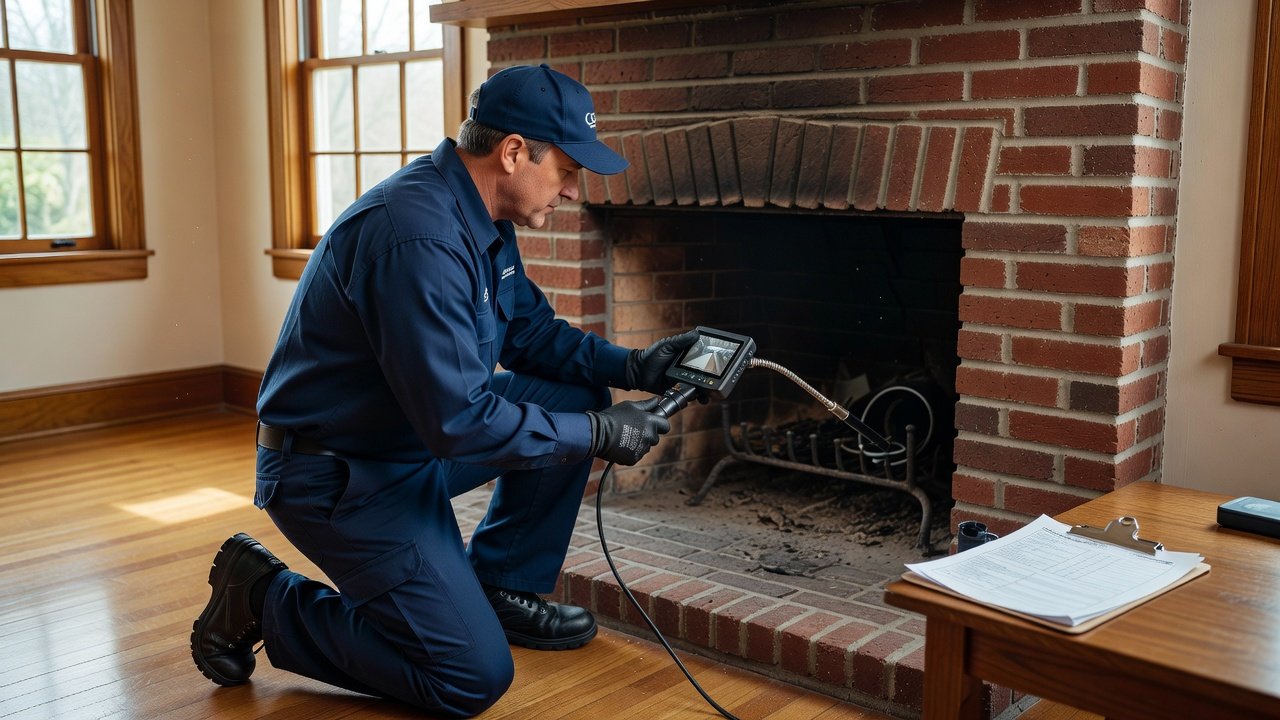
Do not hand over a key and leave. Walk through the findings with our technician. A credible inspector will show you photos or video from the flue camera, point to specific areas of concern, and explain the difference between what needs attention now and what can be monitored. If a company gives you a written report without showing you the evidence, ask to see it.
Our team provides written documentation of every inspection finding. For homeowners in Cherry Hill’s Ashland neighborhood or down toward Merchantville, where many homes changed hands quickly during the 2021-2022 market, that documentation is particularly valuable because those buyers often skipped the chimney evaluation entirely during a competitive purchase.
Step 5 — Act on the Report Within the Same Heating Season
A chimney inspection that produces a list of repairs is only useful if those repairs happen. We see homeowners every spring who had a Level 2 inspection in October, received a report noting liner deterioration or firebox damage, and then used the fireplace through January anyway. Creosote the tar-like byproduct of burning wood becomes highly flammable at stage 3 buildup and can ignite at temperatures as low as 451°F, according to the CSIA. A compromised liner at that point is genuinely dangerous.
Prioritize: liner repairs and crown sealing are structural and safety critical. Cosmetic refacing or damper upgrades can sometimes wait a season. Ask your sweep to rank the findings by urgency and get the safety-critical work done before the next fire.
Troubleshooting Tip: Smoke Smell When the Fireplace Is Cold
If you notice a smoky or musty odor in your living room or den on days when you have not used the fireplace at all, that is almost always a negative air pressure problem drawing air and odor down through the flue. The most common causes are exhaust fans running in the kitchen or bathrooms, a tightly sealed home with insufficient makeup air, or a damaged damper that will not close fully. Before you assume the worst, open a window near the fireplace slightly and see if the smell diminishes. If it does, you likely have an air pressure issue that a damper upgrade or a top-mount damper installation can solve. If the smell persists regardless of what you do, call us it may point to a more serious breach somewhere in the flue system.
What to Expect When You Call Our Team in Cherry Hill
When you reach us, we will ask a few quick questions about your appliance type, when it was last inspected, and any symptoms you have noticed. We schedule inspections throughout Camden County and can typically reach Cherry Hill, Voorhees, and Haddonfield within a few days during the fall season. Our certified sweeps arrive with camera equipment, drop cloths, and written report forms. We do not upsell work you do not need. If we find nothing that requires repair, we will tell you that plainly.
Frequently Asked Questions About Chimney Safety Inspections in Cherry Hill, NJ
How often does a chimney in Cherry Hill really need to be inspected?
The CSIA recommends a professional inspection at least once a year for any chimney or venting system in active use. In Cherry Hill, where homes with 40- to 50-year-old masonry fireplaces are common, annual inspections matter more, not less. Age, freeze-thaw weathering, and decades of use compound the risk. If you have not had an inspection in the past 12 months, schedule one before this heating season begins.
Does buying a home in Cherry Hill mean I automatically need a Level 2 inspection?
Yes. NFPA 211 requires a Level 2 inspection any time a property changes ownership, regardless of how recently the chimney was last swept or inspected. A standard home inspection does not substitute for a chimney-specific Level 2 evaluation, which includes video scanning of the flue interior. We strongly recommend this for any home purchase in Cherry Hill, Voorhees, or Haddonfield where a fireplace or wood stove is present.
Can I use my fireplace while waiting for a chimney inspection appointment?
If you have visible damage crumbling mortar in the firebox, a stuck or missing damper, cracks in the smoke chamber, or any prior chimney fire do not use the fireplace until it has been inspected and cleared by a certified sweep. If you have no known symptoms and the appliance has been used safely through recent seasons, limited use while waiting is generally lower risk, but we would still recommend keeping fires small and monitoring for any smoke backup into the room. When in doubt, wait.
If you are in Cherry Hill, Voorhees, Haddonfield, or anywhere in Camden County and you are not certain when your chimney was last properly inspected, call American Chimney Company today. Our CSIA-certified technicians will give you an honest, documented assessment of your system no pressure, no guesswork, just the information you need to heat your home safely this season. Request your inspection online or call us directly. The cost of knowing is small. The cost of finding out the hard way is not.
Related from American Chimney Company: Chimney Inspection (Level 1 & 2) in Stamford, CT · Chimney Sweep & Cleaning in Yonkers, NY · Chimney & Masonry Repair in White Plains, NY
Our services
American Chimney Company · Chimney Waterproofing Louisville KY · Chimney Cleaning Atlanta GA · Chimney Cleaning Baltimore MD · Fireplace & Dryer Vent Services · Waterproofing & Flashing
Areas we serve
White Plains, NY · Greenwich, CT · New Rochelle, NY · Norwalk, CT · Morristown, NJ · Danbury, CT · Princeton, NJ · New City, NY